
Retinol for beginners comes down to one rule: start slowly. Retinol is one of the most popular skincare ingredients for fine lines, rough texture and uneven tone, but it is also famous for dryness, flaking and redness when people rush it. Used patiently, it can be a useful addition to your routine without wrecking your skin barrier.
This guide to retinol for beginners explains what retinol does, the basic rules, a simple four-week plan for starting, how to deal with dryness and irritation, and what to know if you have deeper skin tones or live in a sunny climate like Kenya. You will also find Oriflame products from My Oriflame Kenya Shop, based on what their product pages state.
What is retinol and what does it do?
Retinol is a form of vitamin A used in skincare to support smoother-looking skin. People use it mainly for fine lines and wrinkles, rough texture and uneven skin tone. Over-the-counter retinol is gentler than prescription retinoids, which are stronger medicines that a dermatologist prescribes, so it is the usual starting point in any retinol for beginners routine.
The catch is that retinol can make your skin dry, red or flaky while it adjusts, and it makes your skin more sensitive to the sun. That is why the way you start matters more than the product you choose.
Retinol for beginners: the basic rules
- Start low and slow. Choose a lower-strength product and begin with one or two nights a week.
- Use it at night only. Retinol can make skin more sun sensitive, and many formulas break down in light.
- Use a small amount. A pea-sized amount is usually enough for the whole face and neck. Keep it away from your eyes, lips and the corners of your nose and mouth.
- Apply it to clean, dry skin. Wait until your skin is fully dry, then follow with a moisturiser.
- Wear sunscreen every morning. Use SPF 30 or higher, and cover your face again if you spend a long time outdoors.
- Add one new product at a time. Do not start retinol in the same week as another new active.
- Stop if your skin burns or becomes very irritated. Moisturise until your skin settles, then restart at a lower frequency.
A four-week plan for retinol for beginners
This is a cautious schedule that you can adjust to your skin. Only move to the next week if your skin feels comfortable, with no stinging, peeling or lasting redness.
- Week 1: Use retinol once, for example on a Monday night. Notice how your skin feels over the next few days.
- Week 2: Use it twice, with at least two rest nights between, for example Monday and Thursday.
- Week 3: Use it two or three nights, with rest nights in between.
- Week 4: If your skin is calm, move to every other night. Many people stay at two or three nights a week long term, and that is perfectly fine.
The Oriflame product page for Retinol Power Drops suggests a similarly gradual start: once a week at first, then twice a week, then more as your skin allows. If irritation appears at any point, take a few nights off, moisturise, and restart at the previous step.

Retinol for beginners: what to do about dryness, peeling and irritation
Some dryness is common in the first few weeks. These habits help:
- Moisturise every night after retinol. If your skin is very sensitive, apply moisturiser first, wait a few minutes, apply retinol, then add more moisturiser.
- Use a gentle cleanser and lukewarm water. Avoid scrubs and harsh toners.
- Skip other exfoliating acids and strong actives on retinol nights.
- Use less product, less often, rather than pushing through discomfort.
- Keep retinol away from your eyelids, lips and the sides of your nose.
See a dermatologist if you have burning, swelling, a rash or irritation that does not settle after you stop using retinol.

Retinol for beginners with dark skin
People of all skin tones can use retinol. A hospital-based skin care article on what retinol does for your skin notes that people with darker skin need to be especially careful about irritation, because irritation can lead to hyperpigmentation in skin of colour. It also suggests starting with the least potent formula and using it every other night at first before building up.
In practice, retinol for beginners with deeper skin tones means a slower start, patch testing a new product on a small area first, avoiding other irritating products on the same night, and wearing sunscreen every morning. Our guide to the best anti-aging routine after 35 explains where retinol fits into a wider routine, and our 5 step skincare routine shows how the renew step fits with the others.
Who should avoid retinol or ask a professional first
- If you are pregnant, trying to conceive or breastfeeding, check with a doctor or healthcare professional before using retinol.
- If you have very sensitive skin, eczema, rosacea or an active skin condition, speak to a dermatologist first.
- If you are already using prescription skin treatments, do not add retinol without professional advice.
- If your skin is sunburnt, broken or already irritated, wait until it has healed.
Retinol and Kenya’s strong sun
UV rays are strong near the equator, and retinol makes your skin more sensitive to them, so sun care is a key part of retinol for beginners. Use retinol at night, wear a broad-spectrum sunscreen of SPF 30 or higher every morning, and reapply if you are outdoors for long. Also keep your retinol product away from heat and direct sunlight, for example a hot bathroom shelf or a bag left in the sun.

Retinol for beginners: Oriflame products to consider
These products are available at My Oriflame Kenya Shop. The details below come from their product pages. Prices can change, so check the current price on each page before you order.
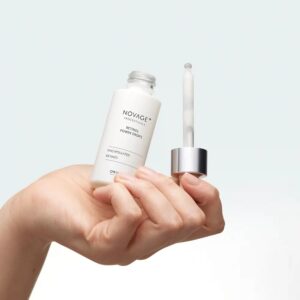
- Novage+ Proceuticals Retinol Power Drops: A care product with 1.1% microencapsulated retinol, which the product page says is equivalent to 0.1% pure retinol in this formulation. The retinol is held in a thin polymer shell designed to keep it pure and effective until it touches the skin, and the page says this makes it gentler than other types of retinol. The page says to apply it in the evening, avoid the eye area, and start with once a week, then twice a week, then increase. It notes that slight tingling may occur, advises against using vitamin C at the same time, and says to use AHA, BHA and PHA acids on separate days. Listed at KSh 6,500 at the time of writing.
- Skinrelief Pro Resilient Serum: A serum made for sensitive skin that the product page says is fragrance-free and pH-balanced. It contains DermaLift Active, which the page describes as a gentle, retinol-like anti-ageing active. Retinol-like is not the same as retinol, but it may suit you if you want a gentler option. Listed at KSh 6,500 at the time of writing.
- Novage+ Proceuticals 24s Intensive Moisturizing Power Drops: A moisturising serum with polyglutamic acid that the product page describes as clinically tested for 24-hour moisturising. The Retinol Power Drops page lists it as a good partner to use with retinol. Listed at KSh 5,200 at the time of writing.
- Novage+ Proceuticals Ultra Light UV-Anti-Aging Day Cream + SPF 50: A lightweight SPF 50 day cream for all skin types, including sensitive skin. Its product page reminds you to use SPF 50 when using active ingredients such as vitamin C, retinol and AHA. Listed at KSh 5,500 at the time of writing.
If you are also thinking about vitamin C, our guide to niacinamide vs vitamin C serum explains how to choose and how to keep your routine simple.
Retinol for beginners: common mistakes to avoid
- Using retinol every night from the first day.
- Applying too much. More product does not mean faster results.
- Using retinol on damp skin, which can increase irritation.
- Skipping moisturiser and sunscreen.
- Using vitamin C, exfoliating acids and retinol all at once.
- Applying it to the eyelids, lips or the creases around the nose and mouth.
- Giving up after two weeks, or expecting results overnight. Most products need several weeks of consistent use.
- Starting during a time when your skin is already sunburnt, irritated or very dry.
Frequently asked questions
What is the best retinol for beginners?
The best retinol for beginners is a low-strength product that you can introduce slowly and that comes with clear instructions. Patch test first, begin with one or two nights a week, and moisturise afterwards. If your skin is very sensitive, ask a dermatologist before starting.
How often should a beginner use retinol?
Start with once or twice a week and only increase if your skin stays comfortable. Many people use retinol two to three nights a week long term, and every other night is a common ceiling for sensitive skin.
Is retinol for beginners safe on dark skin?
Yes, people of all skin tones can use retinol. Because irritation can leave marks on deeper skin tones, start with a gentle product, patch test, increase slowly and wear sunscreen every morning.
Can I use vitamin C and retinol together?
Not at the same time. A common approach is to keep them in separate parts of your routine, with vitamin C in the morning and retinol in the evening. The Oriflame Retinol Power Drops page specifically says not to use vitamin C at the same time.
Should I use retinol in the morning or at night?
Use it at night. Retinol can make your skin more sensitive to the sun, so pair it with sunscreen the next morning.
How long does retinol take to work?
It takes patience. The Oriflame Retinol Power Drops page suggests using the product for 4 to 8 weeks for best results. If you see no improvement after a few months, or your skin stays irritated, speak to a dermatologist.
Conclusion
Retinol for beginners is about patience, not strength. Start slowly, apply it at night, moisturise afterwards and wear sunscreen every morning. Increase the frequency only when your skin is calm, and stop if it burns or becomes very irritated. Give it several weeks before you judge the results.
Ready to start? Explore the serums and boosters at My Oriflame Kenya Shop and choose a product that suits your skin.
This article is for general information and is not medical advice. If you are pregnant or breastfeeding, or have a skin condition, speak to a doctor or dermatologist before using retinol.
-
Best sellers
 Original price was: KSh 6,500.KSh 5,500Current price is: KSh 5,500.
-
Best sellers
 Original price was: KSh 3,500.KSh 3,000Current price is: KSh 3,000.
-
Best sellers
 Original price was: KSh 3,500.KSh 3,000Current price is: KSh 3,000.
-
Best sellers
 Original price was: KSh 2,500.KSh 1,800Current price is: KSh 1,800.

-
Skincare
 Original price was: KSh 2,000.KSh 1,499Current price is: KSh 1,499.
-
Skincare
 Original price was: KSh 3,500.KSh 3,000Current price is: KSh 3,000.
-
Skincare
 Original price was: KSh 4,500.KSh 3,900Current price is: KSh 3,900.
-
Skincare
Original price was: KSh 4,500.KSh 3,900Current price is: KSh 3,900.
-
Skincare
 Original price was: KSh 3,500.KSh 3,000Current price is: KSh 3,000.